
Building the PCX substrate from tokenized transaction records
Patents
ValiDeck’s patent portfolio reflects the evolution of PCX from its original token-based transaction model into a broader privacy-preserving architecture for digital commerce. At its centre is a consistent technical objective: enabling verified transaction records to support trusted digital services while preserving customer control and maintaining clear boundaries around personal and commercially sensitive information.
The portfolio is directed not merely to individual product features, but to the underlying infrastructure — the data structures, trust boundaries, cryptographic controls, transformation processes, and constrained interfaces through which PCX operates. This architectural focus is intended to protect the durable technical principles of the system as well as the applications those principles enable.
All of the underlying inventions originated within ValiDeck. The company directs a coordinated prosecution strategy across multiple jurisdictions, seeking protection for the core architecture and its successive extensions rather than assembling the portfolio through licensed or acquired technologies.
How the portfolio fits together
Across the portfolio, one architectural objective remains constant: verified transaction data should support useful services while keeping customer identity structurally separated from the records used to provide them. Each family or application addresses a different layer of the technical separation needed to preserve that boundary.
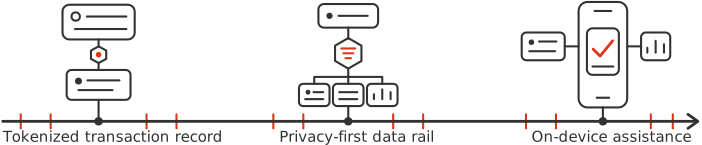
ValiDeck’s patent portfolio is organized around three related layers of PCX. The granted foundation family covers token-based capture and pseudonymous aggregation, while two independent applications filed in 2026 are directed to the later-developed transaction-record and edge-assistance architectures. Taken together, they trace PCX’s progression from verified record capture to privacy-preserving analytics and user-controlled assistance.
01
Foundation family
Token-based capture and pseudonymous aggregation.
Granted in the US, Australia and India
02
Transaction architecture
Separated customer, merchant and synthetic analytic records.
Filed May 2026
03
Edge assistance
Protected canonical records and on-device assistance.
Filed June 2026
Foundation patent family
The portfolio begins with the family directed to ValiDeck’s original token-based transaction model. Its capture and pseudonymous aggregation mechanism forms the technical foundation for PCX. Patents have been granted in the United States, Australia and India, while related applications remain under examination in Canada, Europe and China.
The portfolio begins with ValiDeck’s original token-based transaction model. Its capture and pseudonymous aggregation mechanism forms the technical foundation for PCX. This family now includes two granted U.S. patents, with counterpart patents granted in Australia and India. Related applications remain under examination in Canada, Europe and China.
COUNTERPART PATENTS
The foundation patent is directed to the token-based capture of pseudonymous customer transaction records and their aggregation into a customer-controlled record capable of supporting a loyalty program without exposing customer identity to the platform operator.
UNDER EXAMINATION
Canada
Europe
China
UNITED STATES CONTINUATION
Granted September 29, 2026. This continuation covers PoS-linked customer transaction records and contextual review forms tailored to a product or service, with future forms refined through reviewer choices.
.
2026 filings
As PCX evolved beyond tokenized capture, ValiDeck developed two additional architectural layers and filed independent applications for them in 2026. One is directed to privacy-compliant transaction records and analytics; the other addresses protected, user-controlled assistance at the edge.
TRANSACTION RECORD ARCHITECTURE
Systems and Methods for Generating Privacy-Compliant Transaction Records and Analytics
US19689697 / EP26181387 · Filed May 27, 2026
What it covers
This application describes a privacy-preserving transaction architecture that transforms verified completed transactions into separated customer, merchant and synthetic analytic records. The synthetic analytic records exclude customer identity, merchant-sensitive data, SKU-level detail, exact prices and exact timestamps, while preserving enough structure to generate transaction-verified analytics.
What it supports
The system supports repeat and drop signals, cross-merchant behavioral analytics, transaction-linked reviews, loyalty rewards, and search and discovery outputs without exposing raw transaction histories or merchant operational data to the platform. It combines canonical normalization, trusted transformation, separated storage domains, non-payload linkage metadata and constrained query interfaces.
Role in PCX: creates the trusted transaction-record and analytic substrate.
PROTECTED EDGE ASSISTANCE
Systems and Methods for On-Device Generation and Lifecycle Management of Assistance Artifacts
US19723634 / EP26188354 · Filed June 29, 2026
What it covers
This application describes a privacy-preserving on-device assistance architecture that transforms authoritative domain records into qualified canonical records retained under protected user-associated custody. The architecture separates local canonical evidence from remote synthetic comparative records, allowing user-specific assistance to be generated without centralizing personal record histories or exposing canonical record payload content to the remote platform.
What it supports
The system supports evidence-based reminders, recommendations, eligibility indicators, maintenance and warranty assistance, product-lifecycle notices, loyalty functions, health-related assistance and cross-plane comparative outputs. It combines controlled record qualification, cryptographic access controls, separate canonical and synthetic storage domains, bounded local query contributions, non-reconstructive comparative outputs, artifact lifecycle management and authorization-controlled export.
Role in PCX: extends the trusted record substrate into protected, user-controlled edge assistance.
Earlier work
Granted — directed to a smart-wallet device. This is earlier work by the same inventor. It is separate from the PCX protocol architecture and does not underpin the claims above.
Support
Intellectual Property Ontario
Patent costs are supported in part by Intellectual Property Ontario (IPON) on a project-by-project basis.