
Building the world's privacy-first transaction data infrastructure for commerce
Roadmap
ValiDeck’s roadmap sets out the work required to advance PCX from a specified privacy-first protocol into shared transaction data infrastructure that allows transaction records to work across merchants without exposing customer identity. The work runs in two separately funded phases — Phase I and Phase II — from completed architecture to demonstrated implementation, followed by expansion that is conditional on evidence rather than scheduled.
The architecture and the Phase I program design are complete, and the patent foundation is established across multiple jurisdictions. The next step is to secure funding and execute Phase I — building and independently validating the first reference prototype using simulated transaction records rather than live commercial data. Phase II begins only if Phase I produces sufficient evidence to support controlled commercial operation.
Phase I establishes and validates the core data platform. Phase II uses the validated infrastructure to enable privacy-preserving services and commercial applications. Each phase carries its own capital requirement and ends in an investment decision that can go either way. The sequence is deliberate. Nothing in Phase II can be built before the platform exists and has been independently reviewed, and expansion beyond it begins only where trusted sources, permission rules, commercial demand and a credible operating partner are all present.
How the roadmap fits together
ValiDeck’s path to market is governed by one central dependency: commercial services become credible only after the underlying data platform has been built and independently validated. The roadmap therefore moves from completed architecture and patent groundwork to platform validation, and only then to live commercial operation.
The roadmap manages development risk and capital exposure by separating the path to market into distinct decision gates. The completed architecture and patent groundwork provide the starting point. Phase I and Phase II are separately funded commitments, each beginning only when its entry conditions are met and ending with evidence for the next investment decision. Expansion is therefore earned stage by stage rather than assumed at the outset.
01
Groundwork
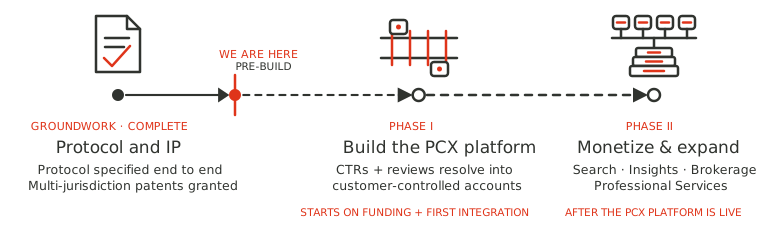
Protocol specified end to end. Patents granted across multiple jurisdictions.
Complete
02
Establish the data platform
Working prototype, reference integration and independent privacy and security review.
24 MONTHS · NEXT
03
Commercialize and expand
Market-ready platform, live partner integrations and controlled pilots with selected organizations.
24 MONTHS · GATED
The two phases
The roadmap is divided into two separately funded phases. Each has defined entry conditions, scope and deliverables, and each ends with a go/no-go investment decision. Phase II begins only if Phase I establishes a credible basis for controlled commercial operation.
Phase I · Establish the core data platform
Build the platform and prove the privacy model
Trigger: funding
Scope
- Build a complete working prototype using simulated transactions drawn from multiple source formats rather than live commercial data.
- Validate the privacy model using realistic transaction histories without requiring ValiDeck to hold customer identity.
- Demonstrate the four initial services: customer-controlled purchase history, transaction-verified reviews, privacy-preserving loyalty, and permitted group-level business intelligence.
- Develop a reference integration showing how a commerce environment connects to the platform and how responsibilities divide among participants.
- Produce independent evidence, including privacy, security and operating reviews, a controlled-pilot plan and the execution plan for Phase II.
Deliverables
- Reviewable prototype: a complete end-to-end implementation an independent reviewer can examine.
- Reference integration: a worked example of how a provider connects and where operating responsibility sits.
- Independent evidence: privacy, security and operating review findings from outside the company.
- Partner package: the controlled-pilot plan and the material a prospective partner needs to evaluate participation.
Why Phase I comes first: Phase I converts the completed architecture into something that partners, reviewers and investors can examine and test. Patent rights establish the legal foundation, but they do not by themselves create a deployable platform or a repeatable route to market.
What Phase I is not: Phase I is not a public launch and not a production system operating on commercial customer data. It does not fund broad sales expansion, mass customer acquisition or production-scale operations.
Phase II · Commercialize and expand
Turn the validated platform into live commercial operation
Trigger: a functioning prototype that handles representative transaction formats; satisfactory independent privacy, security and operating reviews; a workable division of responsibilities among participants; and confirmed partner interest in a controlled pilot.
Scope
- Convert the prototype into the first market-ready platform.
- Establish live partner integrations with participating commerce and payment organizations.
- Operate controlled pilots with selected customers and organizations.
- Strengthen production security and reliability to operating standard.
- Introduce the four services commercially, together with privacy-preserving search.
- Measure adoption, operating responsibility, customer value and commercial viability before wider deployment.
Deliverables
- Market-ready platform: production security, reliability and operating discipline.
- Live integrations: working connections with partner systems rather than reference examples.
- Controlled pilots: operation with real participants under defined limits.
- Evidence of viability: measured adoption and commercial performance sufficient to justify expansion.
Why Phase II is gated: Commercial deployment depends on two things that Phase I must establish: sufficient evidence that the platform works as intended and a partner prepared to take on the required operating role. If either condition is missing, the design or partner model should be revised before proceeding. Launching prematurely would produce weak evidence, limited market insight and no defensible basis for expansion.
How the platform reaches market
Product development and partner development proceed in parallel. The initial route to market focuses on commerce and payment organizations that can provide access to many merchants, rather than requiring ValiDeck to integrate with each merchant independently.
This approach also determines how early capital is used. Phase I does not assume a merchant-by-merchant sales and integration model. The reference integration must therefore demonstrate more than technical compatibility: it must show that the platform can be replicated across merchants without a proportionate increase in integration effort or cost.
Beyond the two phases
As participation grows, the same privacy and operating framework extends to additional categories of authoritative records. Expansion proceeds one category at a time, and only where four conditions are met: trusted data sources, clear permission rules, commercial demand, and a credible operating partner.
Each new category must meet the same standards for record integrity, customer control, independent review and defined commercial use.
Running in parallel
Standardization
ValiDeck intends to advance PCX toward an interoperability standard through European standards and regulatory channels, beginning with PCX-CTR.
ValiDeck would provide the initial reference implementation, while any future standards governance would remain institutionally separate from the company.
Foundation
Defensibility
Granted and pending patent rights provide the initial legal foundation. The PCX architecture is protected by a granted foundation family and two independent 2026 filings covering the transaction-record and edge-assistance layers.
Long-term defensibility will come from more than patents. It will be built through the reference implementation, reusable integrations, operating knowledge, independent validation, growing verified-record coverage, standards participation and an expanding partner ecosystem. Phase I begins building those assets.
Phase I begins when funded
The architecture is complete and the IP is in place. What remains is a 24-month program to build the prototype, complete a reference integration, obtain independent privacy and security review, and assemble the partner package that Phase II depends on.
ValiDeck is speaking with investors and with commerce and payment organizations considering the reference integration role.