
Customer-Owned Transaction Records
The Customer Transaction Record (CTR) is a statement containing information about the money paid for a product or service. When you purchase a product or service online, the transaction record is captured in the merchant/service provider’s database, and you receive an electronic invoice for your purchase via email or some other digital format. If you purchase a product or service offline (e.g., at a brick-and-mortar establishment), the merchant/service provider captures your payment electronically but gives you a paper invoice. An electronic record of the transaction invoice is of tremendous value both to the merchant/service provider and the customer. Merchants and service providers can learn about a customer’s purchasing behavior and run loyalty programs and targeted advertising campaigns on the back of customer transaction records. Customers can potentially use the transaction records to understand their spending and also leverage the same to receive reward points or cashback from merchants/service providers.
Most customers do not have access to CTRs in a consistent electronic format. Offline purchases commonly produce paper receipts, while online purchase records remain in merchant accounts, emails, or merchant databases. The records are therefore fragmented across formats and data silos, leaving customers without a complete, itemized view of their purchases.
The customer is the reason the Customer Transaction Record exists. No purchase, no record. Yet the record is created, kept, and used by everyone except the person whose purchase produced it. So why do merchants and service providers retain a copy of customer transaction records, and the customer profile attached to them, in their own databases? How does this process work, and what would it take to invert it — so that the customer controls the record, decides who sees it, and can share it with a merchant without handing over an identity along with it?
Problems with the retention of Customer Transaction Records
Many merchants/vendors and some banks issue co-branded payment cards to customers, and the customers earn reward points or cashback every time they make a purchase at a designated store or business establishment using the co-branded card. When customers take a co-branded payment card from a merchant/vendor or bank, they sign up for an agreement with the card issuer whereby their transaction records are retained by the merchant/vendor or bank and used for promotions, business insights, etc. Merchants, vendors, and banks do not share customer transaction records with their competitors and must abide by any applicable privacy laws specified by the regulator (typically a government body). The said practice, although favorable both to merchants/service providers and customers, is limited in scope and benefits. When a customer is issued a co-branded card, he/she earns reward points or cashback only if the card is used at establishments that are a part of the issuer’s network. If the customer uses the co-branded card at an establishment not part of the network, the customer receives no benefit because the card issuer does not profit from a purchase initiated outside its network.
A customer retention system linked to a merchant/service provider-specific payment card has other problems as well. Every time a customer signs up for a co-branded payment card, they give their private and confidential information to a business that may be unable to protect the information from theft and/or misuse. Secondly, when a customer signs up for another payment card, the number of cards they need to store and manage increases. Digital wallets help with managing payment cards, but don’t assist with acquiring a card. Payment cards loaded into a phone still require the customer to disclose their personal and confidential information at the time of acquisition. The wallet is a convenience. It removes the plastic, not the disclosure.
What Customer Control Would Require
Inverting the default system does not require new law or better corporate behavior. It requires a record that can be captured once, at the point of payment, and written to an account the customer controls — without the merchant learning who the customer is, and without the bank learning what was bought. Three conditions have to hold at the same time. The record must be complete, down to the line item, or it is not worth keeping. It must be captured without identity, or it cannot be consolidated lawfully. And no single party in the chain may be able to reassemble the whole picture — not the merchant, not the bank, and not the platform holding the records.
What Consolidated Records Make Possible
Once online and offline CTRs are captured in the same structured format, they can be consolidated within a customer-controlled record. The illustration below shows the intended result: line-item purchase records from multiple merchants and transaction channels brought together without requiring any merchant to hold the customer’s complete purchasing history.
For the customer, a consolidated history of CTRs provides a complete view of purchases and spending across merchants. When analyzed at cohort level rather than customer level, the same records can reveal patterns such as repeat purchasing, product switching, and preference for a particular service provider—without identifying any individual customer. These patterns can help businesses plan manufacturing, distribution, and inventory using evidence of actual purchasing behavior.
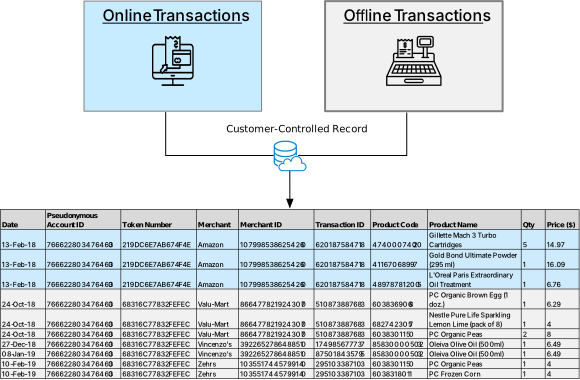
Consolidating CTRs creates a single source of truth (SSOT) about what was actually bought — and replaces the guesswork that fragmented, identity-bound records force on everyone who depends on them.
Today, however, the transaction record available to a customer through their bank or payment-card issuer does not contain an itemized list of the products or services purchased. When a customer pays by card, the merchant/service provider transmits only the merchant’s name, address, and total transaction value to the card issuer.
Where the card issuer and merchant are the same entity, the merchant may have access to both purchase information and the customer’s personal information. Where they are separate entities, the card issuer generally receives the merchant and transaction total, but not line-item purchase information, while the merchant does not receive the customer’s personal details from the issuer.
Capturing the Record Without the Identity
A customer transaction record does not need to be printed. It can be recorded electronically into the customer’s personal account instead, and the information captured can assist the customer, merchants/service providers, and the rest of the world. E-commerce portals like Amazon capture customer transaction records electronically in a structured format. This benefits Amazon as well as the customer. When Amazon captures a transaction record, it allows the customer to submit a review of the product that he/she acquired and purchase the same product again by clicking the transaction record. Amazon extracts significant market insights from the transaction records and uses the information to optimize its business processes. However, Amazon’s strategy for capturing customer transaction records is not the best. Firstly, Amazon requires that before a customer makes a purchase, he/she needs to add a payment method. This is typically a credit/debit card or an Amazon gift card. Secondly, Amazon requires customers to provide their email addresses when creating their Amazon account. These requirements give away a customer’s private and confidential information to Amazon. Finally, the customer transaction records captured by Amazon are not available to the customer’s trusted network or even the rest of the world. Since the data is locked in Amazon’s databases, it is impossible to aggregate the values of such records with the values from other sources of customer transaction records, such as another merchant/service provider’s transaction database.
A merchant can receive a verified transaction record, and run a loyalty program on the back of it, without ever receiving a customer’s personal information. The payment card is already tokenized by the industry; the token, not the customer, becomes the thing the record is filed against. Identity stays with the bank, which has already verified it. The record travels without it. We describe how that works in Token-based Loyalty Program.
Protecting Customersʼ Private and Confidential Information
Records captured this way give the customer instant visibility of their own spending across every payment method and card they hold, and let them join a merchant’s loyalty program without handing over anything confidential about themselves. What makes this work is not a promise. It is who can see what.
Each party sees only what it needs. The merchant sees the transactions a customer chose to share with it, and computes loyalty credits from them — but sees nothing of that customer’s purchases elsewhere unless the customer consents. The bank sees that money was spent, and where, but not what was bought: the line items never reach it. The platform holding the records does not know who is behind the token, because the bank is not required to tell it. The only party with a view of the whole is the customer. And when that customer shares a record, the record moves without the identity — decoupled at capture, not stripped out afterwards.
Closing Thoughts
The Internet is flooded with fake and manipulated information because big businesses have eliminated competition from the market. A centralized repository of reviews and customer transaction records can restore the credibility of online information and create a level playing field for small and medium businesses.
Most people throw their transaction invoice soon after accepting the sale unless the purchase comprises items that are either high value (e.g., television, cellphone) or require the correct fit (e.g., apparel). When an invoice is retained, it is mostly in a format that is not amenable to electronic processing. A centralized repository of Customer Transaction Records can assist in capturing contextually relevant feedback for every product/service provider via quick and easy forms. When transaction records are stored at a central location, it also becomes possible to analyze spending, check transactions, measure consumer behavior, lookup reviews, and identify service providers trusted by our social network.
Customer-controlled transaction records are not a concession extracted from industry. They are a better arrangement for everyone in the chain — the customer who finally sees their own spending, the merchant who gets verified demand signal instead of a guess, the bank that keeps custody of the identity it already holds, and the regulator who can audit the system without demanding raw data about anybody. The record was always the customer’s. The infrastructure to treat it that way is what has been missing.